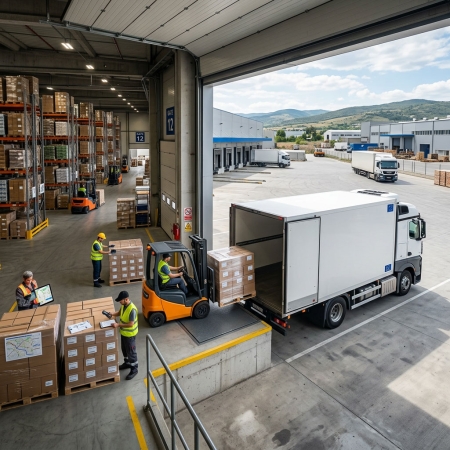
For manufacturing companies, distributors, trading facilities and logistics teams in and around Plovdiv, a reliable delivery does not begin when the truck sets off. It starts earlier — with cargo readiness, warehouse organisation, the loading window, documentation and the consignee’s delivery deadline.
When these elements are aligned, transport becomes more predictable. When they are not, waiting time, rescheduling, additional clarification and the risk of delays can arise. This is where the link between a warehouse location and transport planning can add real value.
Radinovo is an important logistics location for companies operating in the Plovdiv region and the surrounding industrial zones. When the warehouse forms part of a broader logistics process, it can support goods receipt, temporary storage, shipment preparation and better planning of the onward delivery.
Quick answer: when can the Radinovo warehouse support deliveries from Plovdiv?
The warehouse location in Radinovo can be useful when goods are ready before the transport window, when production is completed in stages, when cargo needs to be prepared for dispatch or when delivery to the consignee must be coordinated with a specific time slot.
This does not mean that every shipment should pass through a warehouse. If the cargo is fully ready, the route is clear and the consignee can accept delivery within the agreed timeframe, direct transport may be the more appropriate option. A warehousing stage makes sense when it solves a specific organisational issue.
Why is the connection between Plovdiv and Radinovo important for logistics planning?
Plovdiv and the surrounding industrial zones form an active manufacturing and warehousing environment. Companies in the region operate with different cargo flows, schedules and dispatch requirements. One facility may have fixed loading hours, another may operate under controlled access procedures, while a third may have limited space for finished goods.
In this environment, a warehouse can act as a buffer between production and transport. This is particularly useful when goods need to leave the production facility but the appropriate time for international delivery or distribution to the consignee has not yet arrived.
Radinovo can form part of this process when the location, timeframe and type of cargo allow for better organisation through intermediate storage and preparation.
How can warehousing support production logistics?
When the goods are ready before the transport
In manufacturing operations, there is often a gap between the moment the goods are ready and the time when transport is scheduled to depart. If finished products remain in the production area for too long, they may occupy valuable working space, interfere with subsequent operations or create pressure on the dispatch process.
A warehouse buffer allows the goods to be moved, organised and held until the appropriate transport window. This enables production to continue more smoothly while transport is planned according to the consignee’s actual delivery requirements.
When the shipment is assembled in stages
For some deliveries, not all items, pallets or batches are ready at the same time. This is common for manufacturing companies, commercial deliveries, campaign-based orders or goods prepared by different internal departments.
Instead of sending several separate shipments, the goods can be consolidated at a warehouse location, assembled and prepared for one better-coordinated delivery. This can simplify the process for both the consignor and the consignee.
When the consignee has a fixed delivery slot
Many European warehouses, distribution centres and manufacturing facilities operate with specific delivery slots. If the cargo arrives outside the agreed window, waiting time or rescheduling may be required.
When the goods have already been prepared in a warehouse, transport can be planned more precisely around the required delivery time. This reduces the risk of rushed loading, incomplete documentation or last-minute changes.
What can the connection between warehousing and transport include?
The practical link between warehousing and transport depends on the specific cargo. In one case, the warehouse may provide only short-term storage. In another, it may include goods receipt, organisation of the cargo, shipment preparation, coordination with the carrier and subsequent loading.
The process may typically include:
- receipt of goods at the warehouse location;
- temporary storage until the transport window;
- organisation and preparation for dispatch;
- coordination of loading;
- clarification of documentation;
- planning of the onward delivery;
- communication in the event of schedule changes.
When these activities are agreed in advance, the warehouse is not simply a place where goods wait. It becomes part of the actual delivery organisation.
When is direct transport the better option?
Not every delivery requires a warehousing stage. If the cargo is fully ready, can be loaded on time, the consignee has a clear delivery window and no intermediate preparation is required, direct transport is often the more logical solution.
A warehouse buffer is useful when it adds control, time or organisational flexibility. If it does not solve a genuine logistics issue, it may simply extend the process. The decision should therefore be based on the specific cargo, deadline and logistics situation.
What information is required before planning?
To assess whether the Radinovo warehouse can support a particular delivery, the customer should provide accurate information. This helps determine whether a warehouse buffer is required, how long the goods need to be stored and which transport model is appropriate afterwards.
The most important information includes:
- type of goods;
- number of pallets, cartons or other cargo units;
- dimensions, weight and volume;
- date when the goods will be ready or are expected to arrive;
- expected storage period;
- storage condition requirements;
- need for shipment preparation;
- final delivery address;
- required delivery timeframe and consignee time slot;
- required documentation;
- operational contact person.
How does a warehouse buffer support international deliveries?
With international deliveries, any delay at the initial stage can affect the entire route. If the cargo is not ready, documentation is missing or loading is delayed, the truck schedule and the consignee’s delivery deadline may both be affected.
When goods have already been received and prepared at a warehouse, loading can be organised more efficiently. This is particularly valuable for deliveries with fixed deadlines, shipments to distribution centres, regular transport services and goods that need to be handled or consolidated before dispatch.
For specific shipments from the region, customers can also use our local page for international transport to and from Plovdiv when the destination, cargo and required timeframe are already known.
Radinovo as part of a broader logistics process
When used appropriately, a warehouse is not an isolated stage disconnected from transport. It forms part of a sequence: goods receipt, temporary storage, preparation, loading and delivery.
For companies in the Plovdiv region, the Plovdiv – Radinovo warehouse can be relevant when its location and operating model allow for better control of the flow of goods. This can support both internal preparation and subsequent international delivery.
The key is to ensure that the warehousing solution is linked to the actual logistics requirement: timeframe, volume, type of cargo, access, documentation and consignee conditions.
How does N&N Transport Logistics approach warehousing and transport in the Plovdiv region?
N&N Transport Logistics considers warehousing and transport planning as interconnected elements. Depending on the specific situation, the process may include goods receipt, temporary storage, shipment preparation and subsequent transport.
This approach is useful when the customer needs greater predictability between production readiness and the actual delivery date. Instead of addressing each stage separately, the process can be considered as a whole — from the arrival of the goods at the warehouse location to their departure for the consignee.
For more complex deliveries, freight forwarding and brokerage services may also be included when additional coordination, document clarification or communication between several parties is required.
Practical checklist before sending an enquiry
- Are the goods fully ready, or will they be assembled in stages?
- Is temporary storage required before transport?
- How many pallets or cargo units will be received?
- What storage period is required?
- Are there any specific storage requirements?
- Do the goods need to be prepared for dispatch?
- When do they need to be loaded?
- Does the consignee operate with a fixed delivery slot?
- Which documents must accompany the goods?
- Who is the operational contact if the schedule changes?
Planning a delivery from the Plovdiv region?
If the goods need to be received, stored, prepared and then transported, the organisation should begin before the actual loading takes place. This makes it possible to clarify the deadlines, storage conditions, required capacity and appropriate transport model in advance.
Contact N&N Transport Logistics via our Contacts page and send us the main cargo parameters, required timeframe and destination. We will assist with a solution aligned with the actual requirements of your delivery.
When can the Radinovo warehouse support a delivery from the Plovdiv region?
The Radinovo warehouse can be useful when the goods are ready before the transport window, when they are assembled in stages, when the consignee operates with a fixed delivery slot or when preparation is required before the onward shipment.
Is a warehouse buffer always necessary before an international delivery?
No. If the cargo is fully ready, can be loaded on time and the consignee can accept it within the agreed timeframe, direct transport may be more appropriate. A warehouse buffer makes sense when it solves a specific issue related to scheduling, storage or shipment preparation.
What information is required to plan warehousing and transport?
The required information includes the type of goods, number of pallets or cargo units, dimensions, weight, readiness date, expected storage period, storage requirements, final delivery address, delivery timeframe, documentation and an operational contact person.