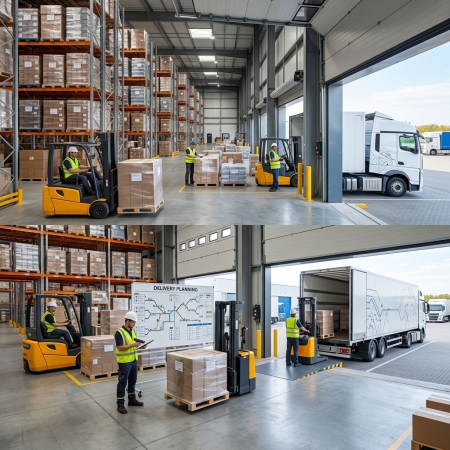
For international deliveries, the first things that often come to mind are the truck, the route and the delivery time. In practice, however, reliable logistics begins earlier — with cargo readiness, available storage space, shipment preparation and coordination between production, warehousing, transport and the consignee.
When these elements are not fully aligned, a warehouse buffer can become crucial. It provides the time and space needed to receive, organise, inspect, consolidate and prepare goods for the next stage of the delivery. This allows transport to be planned according to the actual business schedule rather than under last-minute pressure.
Combining warehousing and transport is particularly useful for manufacturers, distributors, retail chains, importers and exporters working with regular deliveries, seasonal campaigns, part loads or multiple consignees.
Quick answer: when does a warehouse buffer make sense?
A warehouse buffer makes sense when the goods are ready before the transport window, when production is completed in stages, when the consignee has a fixed delivery slot or when several shipments need to be consolidated, separated or prepared for different destinations.
It is also useful when a business does not want every shipment to leave directly from the production line. In such cases, the warehouse helps separate the production process from the transport schedule without losing control over the goods.
Why is a warehouse more than simply a place where goods wait?
In well-organised logistics, a warehouse is not a passive space but an active part of the delivery process. It can receive goods, organise them, hold them until the appropriate transport window, support shipment preparation and facilitate communication between the consignor, carrier and consignee.
This is particularly important for international deliveries because timing depends on more than distance alone. Cargo readiness, warehouse opening hours, loading dock availability, documentation, site access procedures, the consignee’s delivery window and the ability to load on time can all affect the process.
When warehousing and transport are planned together, the business gains greater predictability. Instead of arranging transport at the last minute, the goods can be prepared in advance and dispatched to the customer at the appropriate time.
When does a warehouse buffer solve a real logistics problem?
When production and the transport schedule do not align
Production often follows its own rhythm. Goods may be ready earlier than the planned transport service or may be produced in stages. Without an intermediate storage option, this can put pressure on the production site and make transport planning more difficult.
A warehouse buffer allows finished goods to be moved out of the production area, organised and held until the right loading window. This helps avoid disruption to production while allowing transport to be planned in a more controlled way.
When goods are assembled in stages
For some deliveries, different products, batches or components are not ready at the same time. This is common among manufacturers, promotional campaigns, seasonal deliveries, e-commerce partners and retail chains.
Instead of sending each part separately, the goods can be brought together at a warehouse location, prepared for dispatch and sent as a more efficiently organised shipment. This can reduce the number of separate transport movements and make receiving easier for the consignee.
When the consignee has a fixed delivery slot
Many warehouses, distribution centres and production facilities operate with predefined delivery time windows. If the cargo arrives outside this window, waiting, rescheduling or additional communication may be required.
A warehouse buffer allows the goods to be prepared in advance and dispatched at a time that matches the consignee’s requirements. This is particularly important for international deliveries, where a delay at one stage can affect the entire route.
When there are several consignees or destinations
For deliveries to different customers or markets, a warehouse can support the separation, grouping and preparation of shipments. Each delivery can then be organised according to its own deadline, address, documentation and transport model.
This approach is useful when one production batch needs to be distributed among different consignees or when goods arrive in Bulgaria and subsequently need to be dispatched to several domestic or international destinations.
What does the practical connection between warehousing and transport include?
Good coordination between warehousing and transport begins with clear information. The logistics team needs to know what the cargo is, when it will be ready, how it should be stored, when it needs to be delivered and what conditions apply at the consignee’s site.
In practice, this may include goods receipt, temporary storage, organisation of the goods, shipment preparation, coordination of the loading window and selection of the appropriate transport solution. Where necessary, the process can also be linked to freight forwarding and brokerage services when the shipment requires more complex coordination between different parties.
For international deliveries, the connection with international transport is a natural one. The goods can be prepared in the warehouse and then loaded according to the route, delivery deadline, cargo type and the customer’s requirements.
Dry, temperature-controlled or short-term storage?
Not all goods have the same storage requirements. Some cargo can be stored in dry warehouse areas. Other goods require temperature-controlled conditions, more careful handling or a shorter storage period. This is why the type of product and any specific requirements need to be clarified at the planning stage.
If the goods are sensitive to temperature, humidity, mechanical impact or delivery time, the warehouse buffer must be adapted to those requirements. Otherwise, temporary storage may create more risk than benefit.
For companies operating in the Plovdiv region, a solution such as the Plovdiv – Radinovo warehouse can form part of a wider logistics arrangement when warehousing needs to be combined with onward transport.
What information is required to plan warehousing and transport together?
To propose a workable solution, it is important for the customer to provide accurate information. The clearer the details, the easier it is to determine whether a warehouse buffer is required, how long storage will be needed, what type of storage is appropriate and how the onward transport should be organised.
The most important information includes:
- type of goods and any specific storage requirements;
- number of pallets, dimensions, weight and volume;
- expected date of readiness or arrival;
- required storage period;
- requirements for dry or temperature-controlled storage;
- need for shipment preparation;
- final delivery address or multiple delivery addresses;
- delivery deadline and consignee time window;
- required documentation;
- operational contact person.
When is a warehouse buffer not necessary?
A warehouse buffer is not a universal solution for every delivery. If the cargo is fully ready, the consignee can accept it within the agreed timeframe, the route is clear and no intermediate preparation is required, direct transport may be the more appropriate option.
Warehousing makes sense when it solves a specific problem: mismatched schedules, the need for consolidation, lack of space at the production site, fixed delivery slots at the consignee or the need for temporary storage. If none of these issues exists, adding a warehousing stage may complicate the process without providing a real benefit.
How can a warehouse buffer support cost control?
A warehouse buffer should not be viewed solely as an additional cost. In some situations, it can support better transport organisation, reduce waiting time, improve shipment consolidation and help deliveries meet their required deadlines more accurately.
For example, if several part loads need to be consolidated for the same destination, the warehouse stage can make preparation easier. If the consignee operates with a restricted delivery window, advance storage may reduce the risk of a failed delivery. If the production facility has limited space for finished goods, warehousing can free up capacity and support a more stable operating rhythm.
The benefit should always be assessed on a case-by-case basis — according to the cargo, timeframe, volume, distance, consignee requirements and need for additional preparation.
How does N&N Transport Logistics approach combined warehousing and transport?
N&N Transport Logistics treats the warehouse buffer as part of the practical organisation of the delivery. The aim is not simply to store the goods, but to prepare them for the next logistics stage — domestic transport, international delivery, distribution to consignees or onward shipment.
Depending on the specific case, the solution may include a warehouse location, a transport service, freight forwarding or a combination of several services. For Sofia and the surrounding region, a facility such as the Elin Pelin warehouse may be relevant, while companies in and around Plovdiv may benefit from the warehouse location in Radinovo.
The most important point is that the solution should reflect the customer’s actual logistics requirement. In some cases, direct transport is the best option. In others, better organisation may involve a warehouse buffer that provides additional time, control and a clearer schedule.
Practical checklist before sending an enquiry
- Are the goods ready for dispatch, or will they be assembled in stages?
- Is temporary storage required before transport?
- What type of storage is required — dry, temperature-controlled or another type?
- How many pallets, cartons or other units will be received?
- Are there any specific requirements regarding organisation, labelling or documentation?
- When does the transport need to depart?
- Does the consignee have a fixed delivery time window?
- Will there be one delivery or distribution to several addresses?
- Who is the operational contact if the schedule changes?
Planning a delivery where warehousing and transport need to work together?
If the goods need to be received, stored, prepared and then transported, planning should ideally begin before the cargo arrives at the warehouse. This makes it possible to clarify the timeframe, storage conditions, required capacity and appropriate transport model in advance.
Contact N&N Transport Logistics via our Contacts page and send us the main details of the goods, the required timeframe and the destination. We will assist with a solution tailored to the actual organisation of your delivery.
When is a warehouse buffer useful for international deliveries?
A warehouse buffer is useful when production, cargo readiness and the transport schedule are not fully aligned. It can also support staged consolidation, fixed delivery slots at the consignee, multiple delivery addresses or the need for temporary dry or temperature-controlled storage.
What information is required to plan warehousing and transport together?
The required information includes the type of goods, number of pallets, dimensions, weight, volume, expected readiness or arrival date, required storage period, storage conditions, final delivery address, delivery deadline, documentation and an operational contact person.
Is it always better to use a warehouse before international transport?
No. If the cargo is ready, the consignee can accept it within the agreed timeframe and no intermediate preparation is required, direct transport may be more appropriate. A warehouse buffer makes sense when it solves a specific issue related to scheduling, storage, consolidation or delivery coordination.